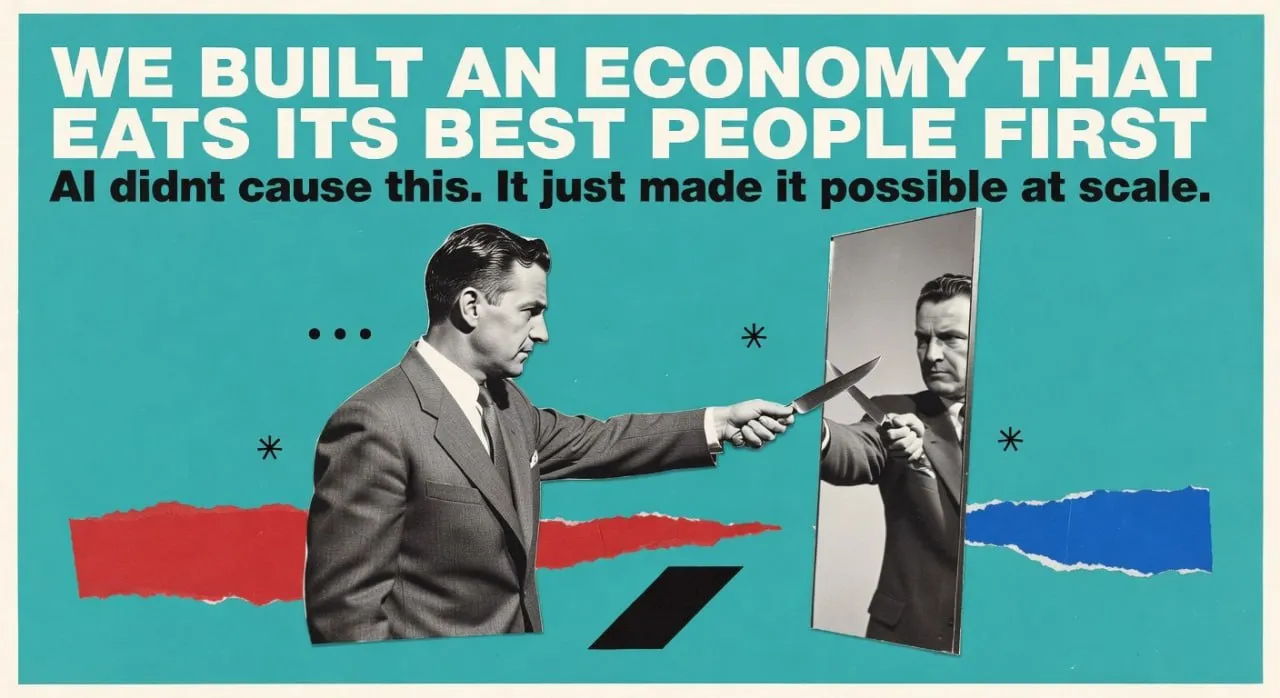
AI didn’t cause this. It just made it possible at scale.
In one month this spring, Anthropic’s revenue rate grew by $15 billion.
In the same window, the rest of the software industry was bleeding. Workday restructured. Salesforce cut another 1,000 people. Meta froze 6,000 hires and announced 10% cuts. Snap let 1,000 go. Atlassian’s stock dropped 36% in a month, then it shed 1,600 people. Block laid off 40% of its workforce. Coinbase cut 14%. Cloudflare cut 20%. Almost every announcement cited AI as the reason.
(A quick note on “revenue rate”: it’s the annual income a company would make if its current monthly pace held for a full year. Not money already in the bank. The size of the firehose. In 30 days, Anthropic’s firehose got $15 billion wider.)
Bloomberg called this the SaaSpocalypse. SaaS, short for Software as a Service, is the subscription business software you pay for per user per month: Salesforce, Workday, Slack, Notion. It’s been the dominant business model in software for fifteen years.
Over about 48 hours in late February, around $300 billion vanished from the combined value of these companies’ stocks. The trigger was specific. On February 24, Anthropic launched Claude Cowork, an AI agent that handles legal review, financial analysis, customer support and project management. (An agent is software that takes actions on its own, not one that just answers questions.) Wall Street did the math fast. The work you used to pay $50 a seat for, you can now run as an API call. Software stocks fell off a cliff.
The piece I’m linking reads all this as strong companies vs weak ones. Strong ones grow with AI. Weak ones use AI as cover for cutting staff. Two roads.
I don’t think that’s quite right.
Take Salesforce. It sells AI agents to its customers, which is supposed to make Salesforce stronger. It also cuts its own staff and tells the market AI is making it more efficient, which is also supposed to make Salesforce stronger. But the same agents Salesforce is selling are eating the reason customers need Salesforce in the first place. Why pay for a sales platform when an agent can do the work directly?
The company is holding the knife and staring into the mirror. The thing it sells to look strong is the same thing shrinking its market.
Underneath that, a quieter shift. Work that used to live inside companies is moving outside them. Not to a contractor. Not to an agency. To an API. The engineer who writes the code. The designer who maps the customer journey. The analyst who builds the financial model. You used to hire them and pay their salary. Now you can buy the output by the task, from a small number of large AI companies.
And the money concentrates, not spreads. Capital flows up to a handful of companies that own the frontier AI models: Anthropic, OpenAI, Google DeepMind. Labour flows out of the firms that used to absorb it. The SaaS middle, the layer that produced tens of thousands of decent knowledge-work jobs, is squeezed from both sides.
Here’s the part I keep sitting with.
At every layer of the economy, the smart, rational, shareholder-friendly move is the same: cut your most expensive resource, which happens to be your skilled humans. AI makes that newly possible without losing short-term capacity. But the aggregate effect is that the most valuable thing in the system, productive people doing skilled work inside firms, is exactly what every smart cut is taking out.
It’s auto-immune. Each company defends itself by attacking the cells that make the whole body work.
“AI-driven restructuring” sounds clean in a press release. On the balance sheet it reads: fewer salaries, more API bills, most of the saved margin going to the few companies that own the models. Business can be fun. Capital still needs watching.
So where does design sit in this?
Not in the layer being absorbed. The work that doesn’t translate cleanly into an API call is exactly the work design has always argued for. Sitting with the people who actually use the service. Figuring out what a problem really is before solving it. Taste. Judgement. The specific situation only this team understands. None of that ships as a plugin.
The risk isn’t that design gets replaced. The risk is that design gets miscategorised, counted as part of the AI efficiency wave and treated as another thing to automate. Refusing that framing is the work. Design is strategic, not decorative. Understanding a problem beats predicting a solution. Systems built to last hold up better than systems built to extract.
SaaSpocalypse isn’t software dying. It’s the firm being redrawn around a much smaller centre. Fewer people inside. More capability bought by the hour. Most of the value collecting at the very top of the stack, where the models are owned.
The question worth sitting with isn’t which of the two roads a company is on. It’s this: when capability is just an API call away, what is left that’s worth being inside a firm for?
I don’t have a clean answer yet. But I know which side of that line I want my work to land on.
Source: Latent Space — AINews: Anthropic growing 10x/year
Originally published on LinkedIn on 2026-05-11. This is the canonical version.